May 14, 2026 • Maren Solley • 9 min reading time • Prices verified June 12, 2026
40L–50L Travel Backpacks for the One-Bag Weekender Who Hates Checking In
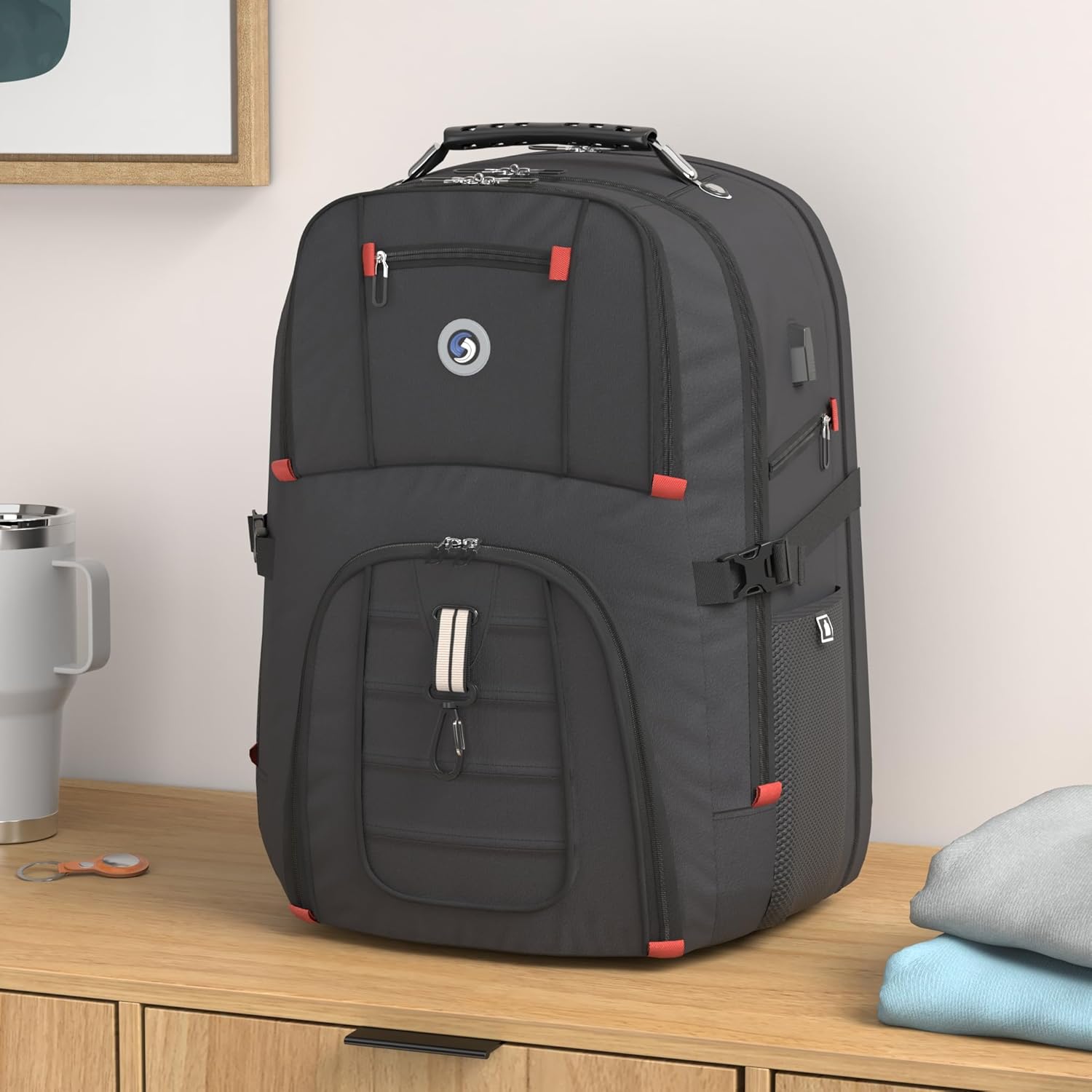
If you’ve ever stood at a baggage carousel watching the belt go around and around while your flight’s early-arrival advantage evaporates, you already understand the appeal of the “one-bag” approach — traveling with a single backpack that fits in an overhead bin (or even under the seat), so you never check luggage at all. The backpacks that make this possible in the 40L–50L range — where “L” means liters of internal volume, roughly the size of a large school backpack — are the sweet spot for travelers who want to pack enough for a week-plus trip without surrendering carry-on status. This guide will help you figure out whether that size range is right for your trip style, what separates a genuinely great one from an overpriced disappointment, and which specific bags are worth your money in 2026.
The tradeoffs in this category are real and worth naming upfront: a 40–50L bag gives you meaningful packing volume, but it sits at the outer boundary of what most airlines allow as a carry-on without scrutiny. Get the choice right and you move through airports faster, avoid checked-bag fees that Smarter Travel’s 2025 baggage-fee tracker puts at $40–$80 per leg on major U.S. carriers, and keep your gear within arm’s reach. Get it wrong — wrong dimensions, wrong bag structure, wrong packing discipline — and you end up gate-checking anyway, which defeats the whole point.
| EDITOR'S PICK[tomtoc Travel Backpack 40L](https://www.amazon.com/dp/B097P4JVP7?tag=greenflower20-20) | Mid-tier[LOVEVOOK Travel Backpack for Wo…](https://www.amazon.com/dp/B0CLVBFRX1?tag=greenflower20-20) | Budget pick[SHRRADOO Extra Large 50L Travel…](https://www.amazon.com/dp/B07V4R4Z77?tag=greenflower20-20) | |
|---|---|---|---|
| Capacity | 40L | 40L | 50L |
| TSA Friendly | ✓ | ✓ | — |
| Case/Lock | — | — | ✓ |
| Packing Cubes | — | ✓ | — |
| Waterproof | — | ✓ | — |
| Price | $89.99 | $41.98 | $29.99 |
| See on Amazon → | See on Amazon → | See on Amazon → |
Why 40L–50L Is the Most Contested Size in Travel Gear
This volume range exists in productive tension. Below 40L, most travelers feel the squeeze on trips longer than four or five days. Above 50L, you’re into territory that almost always needs to be checked on narrowbody aircraft and will trigger gate-check requests on budget carriers. The 40–50L band is where experienced one-bag travelers try to live permanently — and where the gear decisions get genuinely hard.
The airline dimension matters more than bag manufacturers often acknowledge. Per The Points Guy’s updated 2025 carry-on size guide, the most permissive major U.S. carriers (American, Delta, United) allow carry-ons up to roughly 22 × 14 × 9 inches, but international carriers and budget airlines vary significantly — Ryanair, Wizz Air, and Spirit operate with stricter linear-inch limits and inconsistent enforcement that can spike at busy gates. A 45L bag in a tall, narrow form factor (think 21 × 13 × 9 inches) often passes where a 40L bag with a wide, boxy shell gets flagged. Published dimensions on the manufacturer’s website, not the volume number alone, are what you should be cross-referencing against the specific routes you fly.
REI’s expert travel backpack guide makes an important structural distinction that’s worth internalizing: travel-optimized backpacks in this size range are not hiking packs. They open like a suitcase (clamshell or panel-load), carry close to the body on urban streets, and often compress or expand to adapt to different trip lengths. A 45L hiking pack, by contrast, is top-loaded, has an external frame, and is built for trail ergonomics — it will fail a carry-on size check and is exhausting to carry through a city. Make sure you’re shopping the right category.
The Four Variables That Actually Drive the Decision
Once you’ve established that a 40–50L travel pack is the right tool, four variables determine which specific bag is your bag:
1. Structure and access pattern. Clamshell bags (the full zip that opens flat like a suitcase) are easier to pack and faster at security. Panel-load bags open from the front and offer a middle ground. Top-load bags maximize volume but are the slowest to access. For airport-heavy travel, clamshell wins consistently. Condé Nast Traveler’s 2025 travel backpack roundup repeatedly flags clamshell access as a differentiating feature that owners cite in long-term reviews.
2. Harness quality and carry comfort. A 40–50L bag fully loaded will weigh 18–25 lbs. On a 20-minute walk from a metro station to an Airbnb, that difference between a structured, padded harness and a flat panel strap is immediately felt. Owners consistently report that bags with sternum straps and hip belt attachments (even if the hip belt is removable) distribute weight enough to make a meaningful difference on longer carries. If your travel involves airports only and you roll everywhere, this matters less.
3. Organization depth. Laptop sleeve position (does it meet TSA clamshell requirements so you don’t remove it?), internal dividers, water bottle pockets, quick-access top pockets — the layout either matches how you pack or creates friction on every single trip. This is worth thinking through against your actual packing list, not an aspirational one.
4. Airline compliance vs. volume tradeoff. As noted above, published dimensions beat volume as a selection criterion for carry-on compliance. Check the bag’s external dimensions, not just the liter count, against your most-restrictive regular route.
The Bags Worth Knowing in This Category
Here’s an honest look at the options across the price spectrum that consistently earn credible long-form coverage in 2025–2026:
The Osprey Farpoint 40 (~$180)
Osprey’s Farpoint 40 is arguably the most widely reviewed bag in this category, and the pattern across aggregated reviews is consistent: excellent carry comfort for the price, solid organization, and a harness system (with a removable hip belt and stowable shoulder straps that zip away behind a panel) that makes it genuinely dual-mode for travel and light hiking. Outside Online’s 2025 one-bag roundup notes it as a benchmark value pick. The tradeoff is that the 40L Farpoint’s dimensions can push carry-on limits on budget European carriers — verify against your specific routes.
The Osprey Farpoint 55 (~$220)
The 55L version adds a detachable 15L daypack. Owners report that the split configuration is useful for day trips but that the combined bag is gate-check bait on anything smaller than a widebody aircraft. If you’re doing a multi-week overland trip where you’ll check occasionally anyway, this is a compelling system. For pure carry-on operation, the 40L is the safer choice.
The Tortuga Setout 45L (~$299)
Tortuga has built its entire brand around the one-bag traveler, and the Setout 45L reflects that focus. It’s built to meet the most common carry-on size limits (22 × 14 × 9 in), opens in a full clamshell, and has a structured back panel designed for urban carrying. Reviewers at Condé Nast Traveler point to the organizational layout — a dedicated laptop compartment that passes TSA clamshell rules, a front pocket with internal organization, and a water-resistant main body — as a strong match for the specific discipline of carry-on-only travel. The price reflects a genuinely travel-specific design, not a repurposed hiking pack.
The Nomatic Travel Pack 40L (~$330)
Nomatic’s approach is to pack more organizational pockets and tech-friendly structure into a more rigid shell. Owners consistently describe it as excellent for business and tech-heavy travelers — dedicated tablet sleeve, water bottle magnets, packing cube integration — but note that the rigidity and external dimensions require careful checking against carry-on gauges. If your kit is laptop-and-accessories-heavy, the organizational system earns its premium.
The Tom Bihn Synik 30 (~$325) — An Honest Caveat
The Synik 30 comes up in one-bag conversations constantly, but at 30L it sits below this guide’s focus range. It’s worth naming because some travelers find 30L sufficient for 7–10 days with rigorous packing discipline, and Tom Bihn’s build quality (U.S.-made, lifetime warranty, owners report near-zero failures in long-term use) justifies the price at that volume. If you’re already a disciplined packer and questioning whether you need 40L+, the Synik 30 is the honest alternative to consider before committing to a larger bag.
By the numbers: 40L–50L carry-on survival math
| Metric | What to know |
|---|---|
| Average checked bag fee (2025, major U.S. carriers) | $40–$80 per leg (Smarter Travel, 2025) |
| Most common carry-on limit (U.S. majors) | 22 × 14 × 9 in / 45 linear in |
| Typical 40–45L bag packed weight | 18–24 lbs |
| Budget carrier stricter limits (Ryanair, Spirit) | Often 21 × 13.5 × 7.5 in — verify every route |
Packing Discipline Is Half the System
The best 40–50L bag in the world underperforms if you pack it wrong. A few structural principles that owners and experienced one-baggers document consistently:
Compression packing cubes change the math. A good compression cube (brands like Eagle Creek and Peak Design are widely reviewed favorably) can reduce soft goods volume by 30–40%, which makes a 40L bag carry like a 35L bag with the same clothing load. This is not marketing math — it’s why experienced one-baggers treat cubes as part of the bag system, not optional accessories.
Pack for your lightest realistic day, not your heaviest possible day. The tendency is to pack for every contingency. The practical outcome is a 25-lb bag that gets gate-checked anyway. Experienced one-baggers consistently report that the discipline shift toward “I’ll buy it if I need it” for incidentals (an umbrella, an extra layer) is what makes the system actually work across longer trips.
Compression straps are load management, not packing failure. Using the external compression straps on a 45L bag to pull it down to a slimmer profile before boarding isn’t cheating — it’s exactly what they’re designed for. A packed bag at 80% of its volume, cinched down, often passes visual carry-on checks that the same bag at 100% would fail.
The Decision Rule
If you’re trying to close this decision, here’s the frame:
If you fly primarily U.S. domestic or long-haul international on major carriers and want maximum carry-on confidence: the Tortuga Setout 45L or Osprey Farpoint 40 are the most defensible choices — both are sized to the common 22 × 14 × 9 limit, and both have enough structural organization to support 5–10 day trips without checking.
If you fly budget carriers in Europe or Asia regularly: go 40L or under, prioritize published external dimensions over volume, and consider the Osprey Farpoint 40 specifically because the harness stows flat when challenged at the gate.
If your kit is primarily tech and business gear, not soft goods: the Nomatic 40L’s organizational depth earns its premium over the outdoor-focused alternatives.
If you’re questioning whether you need this much volume at all: test yourself honestly against a 30L bag for one trip before committing. A bag that’s too large encourages overpacking, which creates the compliance problem you were trying to avoid in the first place.
The one-bag system rewards specificity. Know your routes, know your real packing habits, and match the bag to both — not to an aspirational version of either.