April 18, 2026 • Maren Solley • 8 min reading time • Prices verified June 12, 2026
Personal Item Duffel Bags for Ultra-Low-Cost Airlines: What Fits, What Doesn't
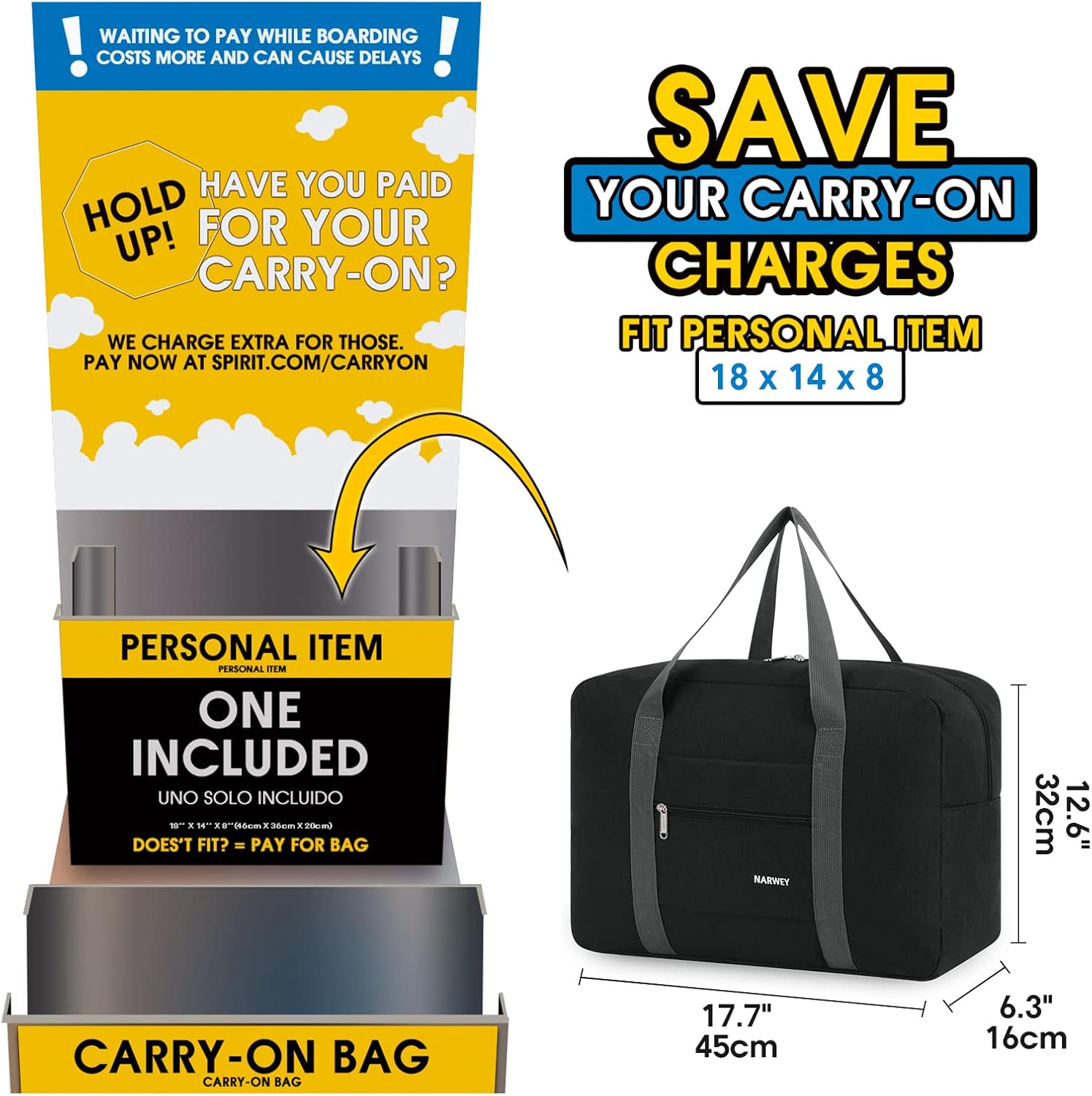
If you’ve ever booked a flight on an ultra-low-cost carrier (ULCC) — airlines like Frontier, Spirit, Ryanair, or Wizz Air that advertise headline fares under $50 — you’ve probably noticed the base ticket price strips out nearly everything, including the right to bring a normal carry-on bag into the cabin. On these airlines, your “free” allowance is almost always limited to a single personal item: a small bag that must fit entirely under the seat in front of you, not in the overhead bin. Think laptop bag, tote, or compact backpack — not a rolling suitcase. Exceed the posted size limit at the gate and you’re looking at fees that can run $50–$100 or more per leg, sometimes eclipsing the fare itself. This guide breaks down exactly which duffel bag styles and dimensions work within ULCC personal-item rules, which don’t, and how to make the decision before you buy.
| EDITOR'S PICK[Spirit Travel Duffel - 18x14x8…](https://www.amazon.com/dp/B0BG55V1QF?tag=greenflower20-20) | Mid-tier[LOVEVOOK Travel Duffle Bag](https://www.amazon.com/dp/B0GWMFX3H4?tag=greenflower20-20) | Budget pickFor Spirit Airlines Personal It… | |
|---|---|---|---|
| Dimensions | 18x14x8 in | — | — |
| Shoe compartment | ✓ | ✓ | — |
| Trolley sleeve | ✓ | — | — |
| Toiletry bag | — | ✓ | — |
| Foldable | — | — | ✓ |
| Wet pocket | — | ✓ | — |
| Price | $33.99 | $28.99 | $9.99 |
| See on Amazon → | See on Amazon → | See on Amazon → |
Why ULCC Personal Item Rules Are a Different Game
Most travelers calibrate their bag-buying decisions around legacy or low-cost carrier rules — the 22 × 14 × 9-inch overhead bin standard popularized by American, Delta, and United. ULCC personal item rules are an entirely separate category, and conflating the two is the single most expensive mistake travelers make.
Here’s the core problem: the size boxes are smaller, the enforcement is stricter, and the fees are structured to be punitive. Smarter Travel’s roundup of ultra-low-cost carrier policies notes that bag fee revenue has become the primary profit driver for ULCCs, which means gate staff have both the policy authority and a financial incentive to enforce size gauges consistently — especially on busy leisure routes.
By the numbers — 2025–2026 ULCC personal item size limits:
| Airline | Personal Item Max (L × W × H) | Overhead Bin Included? |
|---|---|---|
| Frontier | 18 × 14 × 8 in | No (paid add-on) |
| Spirit | 18 × 14 × 8 in | No (paid add-on) |
| Ryanair | 40 × 20 × 25 cm (~16 × 8 × 10 in) | No |
| Wizz Air | 40 × 30 × 20 cm (~16 × 12 × 8 in) | No |
Ryanair’s limit, per the official Ryanair Cabin Bags Policy, is notably tighter than the North American ULCCs — particularly in the width dimension. Wizz Air’s published allowance on their Cabin Baggage page gives slightly more volume but is still well under 20 liters in practice. Frontier and Spirit publish identical limits, per their respective bag policy pages, which makes cross-shopping those routes straightforward.
The practical upshot: you are looking for a bag that maxes out around 18–20 liters on North American ULCCs, and closer to 15–17 liters on European ULCCs. A soft-sided duffel that compresses is your strongest structural ally here — more on that below.
The Duffel Advantage: Why This Bag Shape Outperforms Backpacks in Tight Boxes
When travelers think “personal item,” they usually picture a backpack or tote. Duffels are systematically underrated in this category, and the reason comes down to one property: controlled deformation. A structured backpack with frame sheets, aluminum stays, or rigid laptop compartments cannot compress past its frame. A well-chosen duffel will squash, bend, and reshape to fit the under-seat space even when it’s technically at the outer edge of the allowed dimensions on paper.
Gate agents checking personal items typically use a physical sizing gauge — a wire or molded box mounted near the boarding door. Bags that resist compression will fail this check even if their nominal dimensions are compliant. Bags that compress will often pass even when they’re slightly generous in one dimension. Aggregated traveler reports on routes operated by Spirit and Frontier, compiled in The Points Guy’s ULCC bag fee roundup, consistently show that soft-sided, compressible bags receive less scrutiny than rigid or semi-rigid alternatives.
That said, compression is not a blank check. A duffel stuffed to its structural maximum will not compress meaningfully. The rule of thumb is to pack your duffel to roughly 80% of its stated volume — leaving enough give that the bag will yield to pressure from all sides. Think of the remaining 20% as your “compliance buffer.”
What to look for in a ULCC-viable duffel:
- No external frame or rigid back panel. Even lightly padded back panels on “hybrid” duffels can prevent the bag from flattening under the seat.
- Top-access or side-zip opening, not a full clamshell. Full clamshell openings require perimeter zipper tracks that add structural stiffness around the bag’s edges.
- Grab handle placement that allows vertical or horizontal stowing. Under-seat space on most narrowbody aircraft (Boeing 737, Airbus A320 family) is roughly 9–10 inches tall, 17–19 inches wide, and 18–21 inches deep. A duffel that can orient either horizontally or on its side adapts to the variability across aircraft configurations.
- Volume between 15 and 22 liters depending on your target airline. For European ULCCs, stay at or below 17 liters. For Frontier/Spirit routes, 20–22 liters is workable if the bag compresses well.
Duffels That Work, Duffels That Don’t: A Decision Framework
Rather than a ranked product list, the more durable way to think about this is a decision tree based on your most-traveled routes and the specific ULCC involved. Here’s how to frame it:
If you primarily fly North American ULCCs (Spirit, Frontier, Allegiant):
The 18 × 14 × 8-inch envelope gives you room to work with. Duffels in the 18–22 liter range from manufacturers like Osprey (their Daylite Duffel line), Patagonia (the Black Hole line in smaller variants), and Eagle Creek (the No Matter What series) are designed to comply with this class of constraint, per published specs from those manufacturers. Owners of the Patagonia Black Hole Duffel 25L consistently report that even at 25 liters, the bag compresses aggressively enough to pass Spirit’s gauge when packed conservatively — though 25L is pushing it and not a risk worth taking on a tight itinerary. The 20L version is the safer call.
If you primarily fly European ULCCs (Ryanair, Wizz Air, easyJet):
The tolerance is tighter and enforcement — particularly on Ryanair, based on accumulated traveler reporting across long-run reviews — is notably more consistent than on North American routes. Here, a 15–17 liter duffel is the practical target. Bags like the Matador ReFraction Packable Duffel (rated at 16L per manufacturer specs) or the Ortlieb PS Sport Shopper (15L) are frequently cited in forums and review roundups as reliable within European ULCC limits. The Ortliek’s waterproof construction is a secondary benefit for travelers moving through weather.
If you split time across both:
This is the hardest scenario and where most travelers overpay on bag fees. The honest answer is that no single duffel is optimally sized for both a 16-inch Ryanair limit and an 18-inch Spirit limit — the gap is real. The practical solution used by frequent split-route travelers (documented in gear stack discussions on long-run editorial reviews) is to carry a packable duffel that stores flat inside their main carry-on or checked bag, then deploy it as the personal item only on ULCC legs. The Patagonia Lightweight Black Hole Tote 30L (which also functions as a duffel) packs to a small stuff sack — owners report it passes European gate checks when packed to roughly half capacity, though this is a packing discipline constraint, not a bag-size guarantee.
The Fee Math: When It’s Cheaper to Just Buy the Bag Policy Upgrade
There’s a decision point that doesn’t get discussed enough in personal-item optimization content: sometimes the right answer is not to squeeze into the personal-item limit, but to purchase the carry-on add-on at time of booking.
Here’s the math as of mid-2026 fare conditions: Frontier and Spirit both sell carry-on bag add-ons that start around $35–$45 when purchased during initial booking (per their published bag fee schedules). That price roughly doubles at check-in and can triple at the gate. If your planned trip involves a round-trip on one of these carriers, the round-trip carry-on add-on purchased at booking runs approximately $70–$90 total — less than most mid-range duffels.
The The Points Guy’s ULCC bag fee analysis frames this clearly: the personal-item-only strategy makes economic sense primarily for travelers who fly these carriers four or more times per year. For occasional ULCC flyers, the cost of acquiring, maintaining, and strictly packing a ULCC-compliant kit may not recover relative to simply paying the bag fee. The break-even math favors the dedicated duffel strategy only when the bag’s cost amortizes over repeated compliant uses.
That calculus shifts for frequent flyers, digital nomads on budget routes, and anyone building a long-term kit for sustained ULCC use. At eight or more one-way ULCC legs per year, a $60–$90 compliant duffel pays for itself in avoided fees within a single calendar year.
Three Rules Before You Buy
The decision framework above collapses to three practical rules for anyone currently evaluating duffels for ULCC personal item use:
1. Dimension-check against your specific airline’s published policy, not a generic “personal item” standard. Ryanair’s 40 × 20 × 25 cm limit and Spirit’s 18 × 14 × 8 in limit are not interchangeable — verify against the carrier’s current bag policy page before every purchase.
2. Prioritize compressibility over volume. A 20L soft duffel that compresses to 12L under pressure is more compliant than a “17L” duffel built around a rigid internal structure. Manufacturer-stated volumes don’t capture this; look for owner reports specifically mentioning gate enforcement outcomes.
3. If you fly two or more ULCC systems regularly, buy a packable duffel rated at 15–16L and accept the packing constraint. The alternative — owning two separate personal-item bags optimized for different rules — is the kind of gear redundancy that rarely pays off in practice.
The ULCC personal item game is ultimately about matching your bag’s physical behavior — compressed, stuffed under a seat, under a gate agent’s scrutiny — to a set of rules that were designed to be enforced. Get that match right once, and it stops costing you anything.